
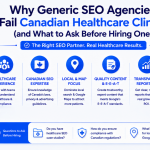

Generic SEO agencies fail Canadian healthcare clinics because they apply the same playbook used for retail, real estate, or e-commerce clients to a YMYL-regulated, PIPEDA and PHIPA-governed industry that plays by fundamentally different rules. The result is usually months of wasted spend on tactics that were never going to work for a medical practice in the first place. Here’s exactly where generalist agencies fall short, and the specific questions worth asking before you sign with anyone.
Why a Generalist SEO Playbook Breaks Down for Healthcare
Most SEO strategy is built around volume: more content, more backlinks, more keywords targeted at once. Healthcare content operates under a stricter quality bar — Google treats every medical page as YMYL and scrutinizes it far more closely than a product page or blog post in most other industries, which means volume-first tactics that work elsewhere routinely underperform, or actively hurt, a clinic’s visibility.
Where Generic Agencies Typically Fail Canadian Clinics
No PIPEDA/PHIPA Awareness
A generalist agency setting up standard tracking pixels and analytics without a second thought about patient data exposure is one of the most common, and most serious, mistakes we see when taking over an account — PIPEDA and provincial laws like Ontario’s PHIPA govern exactly this kind of data flow, and most non-specialist agencies simply aren’t looking for it.
Treating AEO/GEO as an Afterthought
A generalist agency optimizing purely for classic Google rankings is already fighting yesterday’s battle. Patients increasingly ask Google AI Mode, ChatGPT, and Gemini directly, and a strategy that doesn’t build AEO and GEO in from the start leaves a clinic invisible in exactly the moments patients are deciding who to call.
Compliance-Blind Content
Testimonial-heavy landing pages, unverified claims about outcomes, and thin, unattributed medical content are standard generalist SEO tactics — and each one creates real risk for a regulated healthcare clinic, on top of underperforming against Google’s own E-E-A-T standard for medical content.
Wondering if your current agency actually understands healthcare compliance?
What a Healthcare-Specialist Agency Does Differently
A specialist healthcare digital marketing agency starts from a different baseline entirely: content built to E-E-A-T standards by default, local SEO for medical professionals work that accounts for provincial college registries, and medical reputation management services that generate reviews compliantly rather than scraping them straight into unreviewed testimonial blocks.
8 Questions to Ask Before Hiring a Canadian Healthcare SEO Agency
- How many healthcare clients do you currently work with in Canada specifically?
- How do you handle PIPEDA and provincial privacy law compliance in your tracking setup?
- What does your AEO and GEO strategy actually involve, beyond classic keyword rankings?
- Can you show published pricing, or only custom quotes?
- How do you build E-E-A-T signals into medical content specifically?
- Do you have a documented review acquisition process, or ad-hoc requests?
- What happens to my Google Business Profile and CRM data if we part ways?
- Can I speak to a current Canadian healthcare client as a reference?
Red Flags During the Sales Process
- No mention of PIPEDA or PHIPA unprompted — a genuine specialist raises this before you have to ask.
- Portfolio full of unrelated industries with no dedicated healthcare case studies.
- A medical crm software pitch with no mention of speed-to-lead or missed-call automation — a sign the "CRM" is really just a generic contact database.
- Vague promises of "we’ll figure out compliance as we go" — compliance needs to be built in from day one, not retrofitted.
“A generalist agency doesn’t need to be dishonest to fail a healthcare client — it just needs to apply a playbook that was never built for YMYL content in the first place.”
It’s Not Always Obvious From the Outside
To be fair to generalist agencies, this often isn’t a case of bad intentions — a competent generalist SEO team can produce genuinely good work for most industries. The gap only becomes visible once you know specifically what to check for in a regulated healthcare context, which is exactly why so many clinics don’t realize anything is wrong until growth plateaus or a compliance issue surfaces well after the fact.
How Rankingeek Is Different for Canadian Clinics
Through SEO, AEO & GEO services in Canada, Rankingeek builds every engagement around a marketing plan for healthcare organizations that treats PIPEDA and PHIPA compliance, E-E-A-T content standards, and AI search visibility as core requirements from the first strategy call — not add-ons discovered halfway through an engagement.
A Realistic Self-Audit You Can Run Today
Before deciding whether to switch agencies, a clinic can check a surprising amount of this independently in under an hour.
Check Your Own Tracking Setup
Open your site’s intake or contact forms and check whether any patient-submitted information could be flowing into a standard analytics or ad pixel — this alone reveals whether privacy compliance was genuinely considered during setup.
Ask ChatGPT and Gemini Who They’d Recommend
A quick, free test: ask a couple of realistic patient questions about your specialty and city directly in ChatGPT and Gemini. If a competitor is named and you’re not, that’s a concrete, current gap your current agency should already be working on.
Look for a Named Clinical Reviewer on Recent Content
Open a recent blog post or service page and check for an attributed author with real credentials. Generic, unattributed medical content is one of the clearest signs a generalist process is producing your content.
The Cost of Staying With the Wrong Agency Too Long
The real cost of a mismatched agency relationship isn’t just the monthly fee — it’s the months of compounding authority a specialist competitor is building in the same window while your practice produces content that was never going to meet the bar Google and AI engines hold healthcare content to. That gap gets harder, not easier, to close the longer it runs.
Frequently Asked Questions
How can I tell if my current agency is a healthcare specialist or a generalist?
Ask for their current healthcare client list and how they specifically handle PIPEDA compliance and medical E-E-A-T content. A vague or defensive answer is itself a useful signal.
Is it worth switching agencies mid-contract if I suspect this is happening?
It depends on your contract terms, but a documented audit of current gaps — compliance, AEO/GEO readiness, content quality — is a reasonable first step before deciding whether to switch or renegotiate scope.
Do generalist agencies ever work out fine for healthcare clients?
Occasionally, for very basic, low-risk tactical work, but the compounding gaps in compliance awareness and AI search strategy tend to show up as the engagement scales.
What’s the fastest way to audit my current agency’s work?
Check whether your tracking setup avoids passing patient data to third-party platforms, whether your content has attributed clinical review, and whether your practice shows up when you ask ChatGPT or Gemini who they’d recommend for your specialty.
Does a healthcare specialist agency cost more than a generalist one?
Not necessarily — pricing depends more on service scope than specialization. A specialist agency’s advantage is usually efficiency: less wasted spend on tactics that were never going to work for a regulated healthcare client.
Find out exactly where your current SEO strategy is leaving patients — and bookings — on the table.