
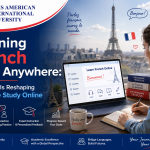
Ask someone why they want to learn French and you'll rarely hear the same answer twice. A job opportunity. A partner's family. A move that's still just an idea. Whatever the reason, the way people go about it has shifted noticeably. More students now choose to learn French online instead of signing up for a rigid classroom schedule, and honestly, it makes sense given how flexible life has gotten for most working adults.
There's something a little ironic about learning French for a life in Paris while sitting in your kitchen three thousand miles away. But that's exactly the appeal.
Why Online French Study Keeps Gaining Traction
Traditional classroom language courses assume everyone's available at the same hour, week after week. That assumption doesn't hold for most adults juggling jobs, families, or time zones that don't cooperate.
Online formats solved that problem without really trying to solve anything else. Students learn French online on their own schedule, repeating lessons when a grammar point doesn't click the first time. Nobody's waiting on them to catch up, and nobody's rushing ahead either.
Truthfully, that pacing flexibility matters more than people expect going in. Language acquisition isn't linear. Some weeks everything sticks. Other weeks nothing does, and pretending otherwise helps no one.
What Effective Online Language Learning Actually Looks Like
Good programs blend structured grammar instruction with actual conversation practice. Not just vocabulary drills repeated into a void.
Speaking practice, even through a screen, forces a kind of discomfort that passive learning avoids entirely. That discomfort is where real progress tends to happen. Students who only memorize word lists without practicing spoken interaction often stall out somewhere around an intermediate level, stuck translating in their heads instead of just speaking.
Choosing the Right Program: What Actually Matters
Not every course that lets you learn French online delivers the same value. Some are barely more than an app with a subscription fee attached.
A few things worth checking before committing:
- Whether instruction includes live interaction, not just pre-recorded videos
- Whether the program tracks progress against recognized language proficiency frameworks
- Whether coursework connects language study to practical, real-world contexts
- Whether the institution offering it has genuine international grounding
That last point gets overlooked constantly, and it shouldn't be.
Where Language Skills Actually Take You Professionally
Fluency in a second language rarely stays a personal accomplishment for long. It becomes a professional asset almost immediately, especially for anyone working across borders or industries that deal with international clients.
Multilingual employees get pulled into negotiations, client relationships, and projects their monolingual colleagues simply can't touch. That's not exaggeration. It's just how global business tends to sort people.
Where Language Study Meets Teaching Careers
Here's what many students overlook. Strong language skills don't just open doors in business. They open a path into teaching itself, particularly for people drawn to helping others learn a second language the way they once did.
That's where a master's degree in TESOL online enters the picture for a lot of former language learners. Teaching English to speakers of other languages requires more than fluency. It requires understanding how adults and children actually acquire language, which is a different skill entirely from simply speaking it well.
Students who've gone through the process of learning a language as adults, especially online, often bring something valuable into a master's degree in TESOL online program. They remember what confused them. They remember which teaching methods actually helped versus which ones just filled time.
The Value of an International Learning Environment
Studying any language within an internationally minded institution adds context no solo app or workbook can replicate. Cultural nuance, tone, regional expressions, these things surface naturally in a classroom pulling students from multiple countries.
Paris American International University has built its language and certificate offerings around this kind of exposure, treating language study as something connected to broader academic and career goals rather than an isolated skill. The approach reflects a fairly simple idea: language learning works better when it's tied to something larger than vocabulary memorization alone.
For students weighing where to learn French online, that broader context is worth considering early rather than as an afterthought once a program's already underway.
Making the Decision
Choosing where to study French, or any language, ultimately comes down to matching format and depth with personal goals. Some students want conversational fluency for travel. Others are building toward something more, whether that's an international career or eventually a master's degree in TESOL online.
Paris American International University represents one option worth researching for students who want flexibility paired with genuine academic structure behind their language education.
There's no single right path here. What matters is finding a program whose pacing, depth, and philosophy actually fit how someone learns best, not just what's convenient this month.